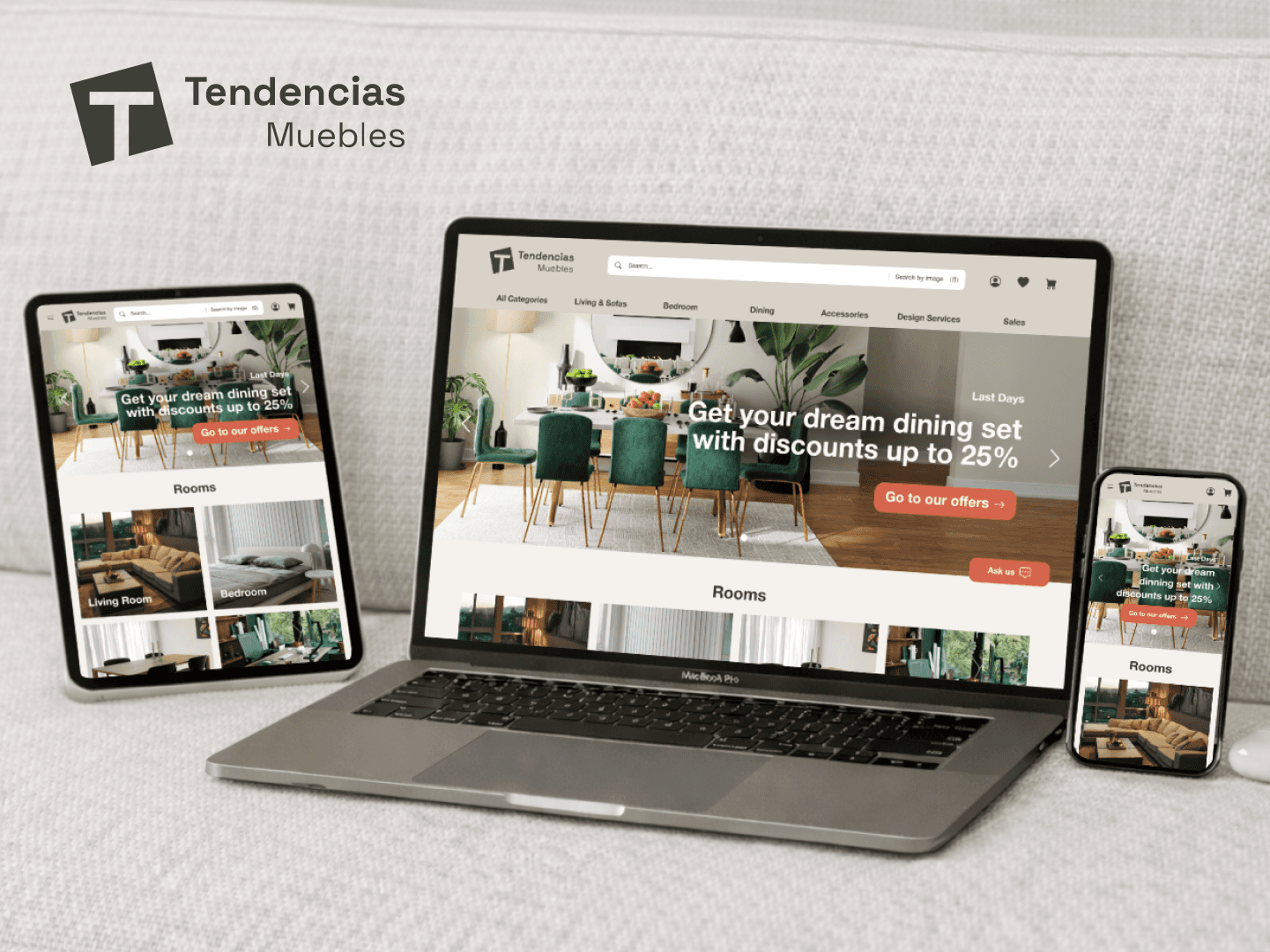
Tendencias Muebles
Designing Trust in Furniture E-Commerce
Client: Tendencias Muebles is a furniture retailer based in Xalapa, Veracruz (Mexico), offering “affordable luxury” furniture since 2001. The business combines physical retail with an underutilized digital presence.
Goal: To transform the existing website into a high-performing digital sales enabler. To bridge the gap between online discovery and in-store conversion.
Duration
2 weeks
Team
Fátima Abel (UX/UI Designer), Jimena Cadena (UX/UI Designer) and Marta Valdés (UX/UI Designer)
Skills
UX Research
UX Strategy
UI Design
Information Architecture
Branding
Tools
Figma
FigJam
Stark
Hand Sketches
Claude
Gemini
Figr
The Impact
Product findability enhance with the new hierachy and search features incorporated.
Sales increase by converting the existing website into a sales conversion channel.
Perceived trust in product information and brand reliability.
The Problem
Customers start their journey online—but the current experience fails to support decision-making.
As a result, high-intent users drop off before purchase, often turning to competitors.
The Solution
We designed a clear, trust-driven e-commerce experience that empowers users to confidently evaluate products before visiting or purchasing.
By prioritizing clarity, guidance, and simplicity, we reduced friction across the entire journey.
The Process
Discover
Market Research
Business Background
Tendencias Muebles is a furniture store founded in 2001 in Xalapa, Veracruz.
They offer modern and stylish furniture at competitive prices, positioning themselves as affordable luxury.
While the physical store performs well, the digital experience was not supporting users during the research and decision phase.
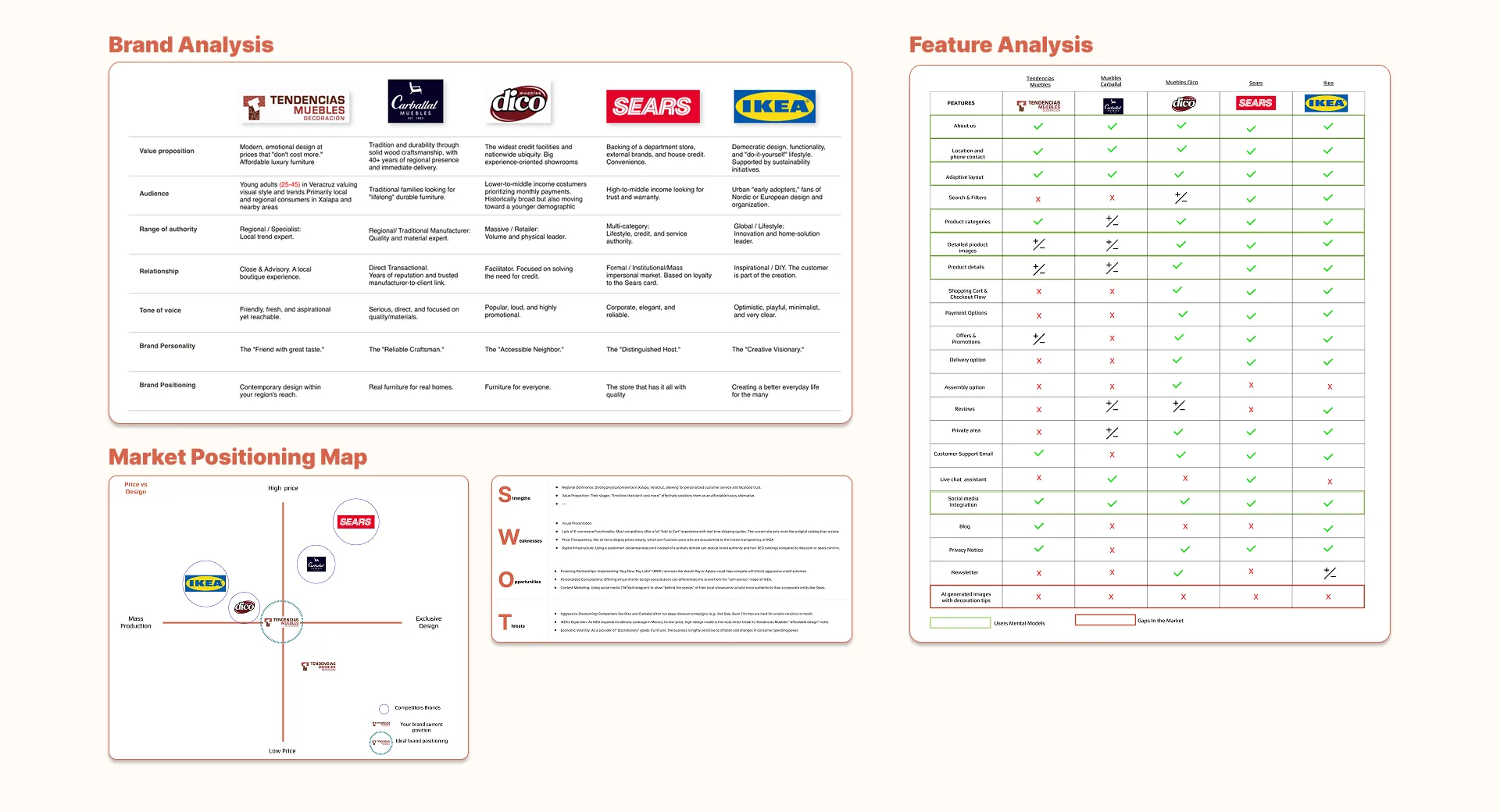
Brand & Features Comparison Charts. Market Positioning Map. SWOT Analysis.
Tendencias Muebles operates in a competitive landscape where large retailers like IKEA, Dico, and Sears are raising digital expectations.
Through brand analysis, feature comparison, positioning mapping, and SWOT, we identified:
Gap: Local competitors lack strong digital experiences despite having strong physical presence
Opportunity: Position Tendencias as a trusted, information-rich digital catalog that supports decision-making
Insight: IKEA leads in inspiration and UX, but Tendencias can win on quality perception and immediacy (fast delivery, local trust)
Strategic angle: Shift from “catalog website” → decision-making platform
Stakeholder Interview
The CEO revealed a critical insight:
Customers already research online before visiting the store
Sales are often lost during the decision phase
The website exists—but is not actively supporting conversions
Key friction: lack of clear, complete, accessible information
This reframed the project:
👉 The website is not just a channel—it’s a sales enabler.
User Research
Quantitative Data: Interviews
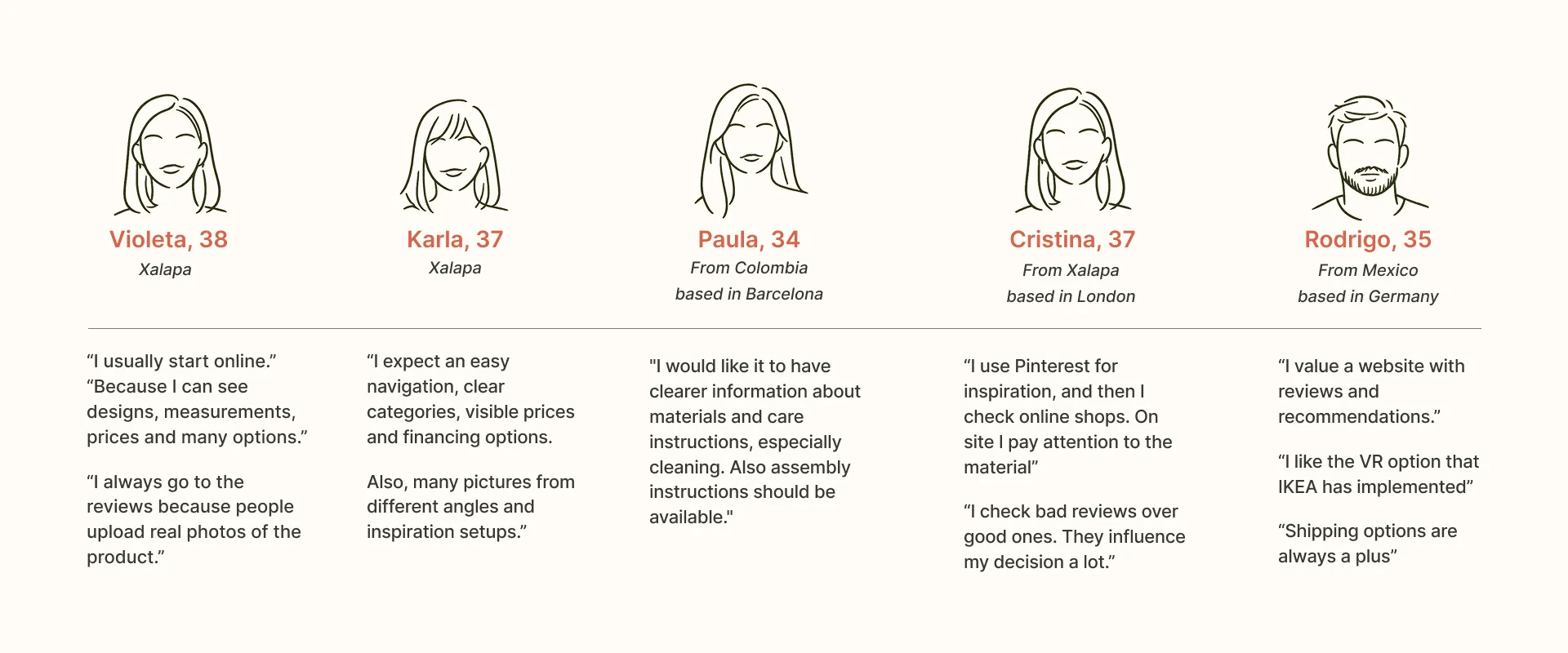
We conducted 5 in-depth interviews (Violeta 38, Karla 37, Paula 34, Cristina 37 and Rodrigo 35) to understand deeper their experiences during the selection and purchase of furniture.
Key patterns:
Users always start online
Strong need for clear product details (dimensions, materials, care)
Reviews and real photos heavily influence decisions
Desire for inspiration-first browsing (Pinterest-like behavior)
Frustration with:
Missing or unclear information
Poor navigation
Lack of trust signals
Expectation of:
Transparent pricing
Delivery clarity
Financing options
Define
Affinity Diagram
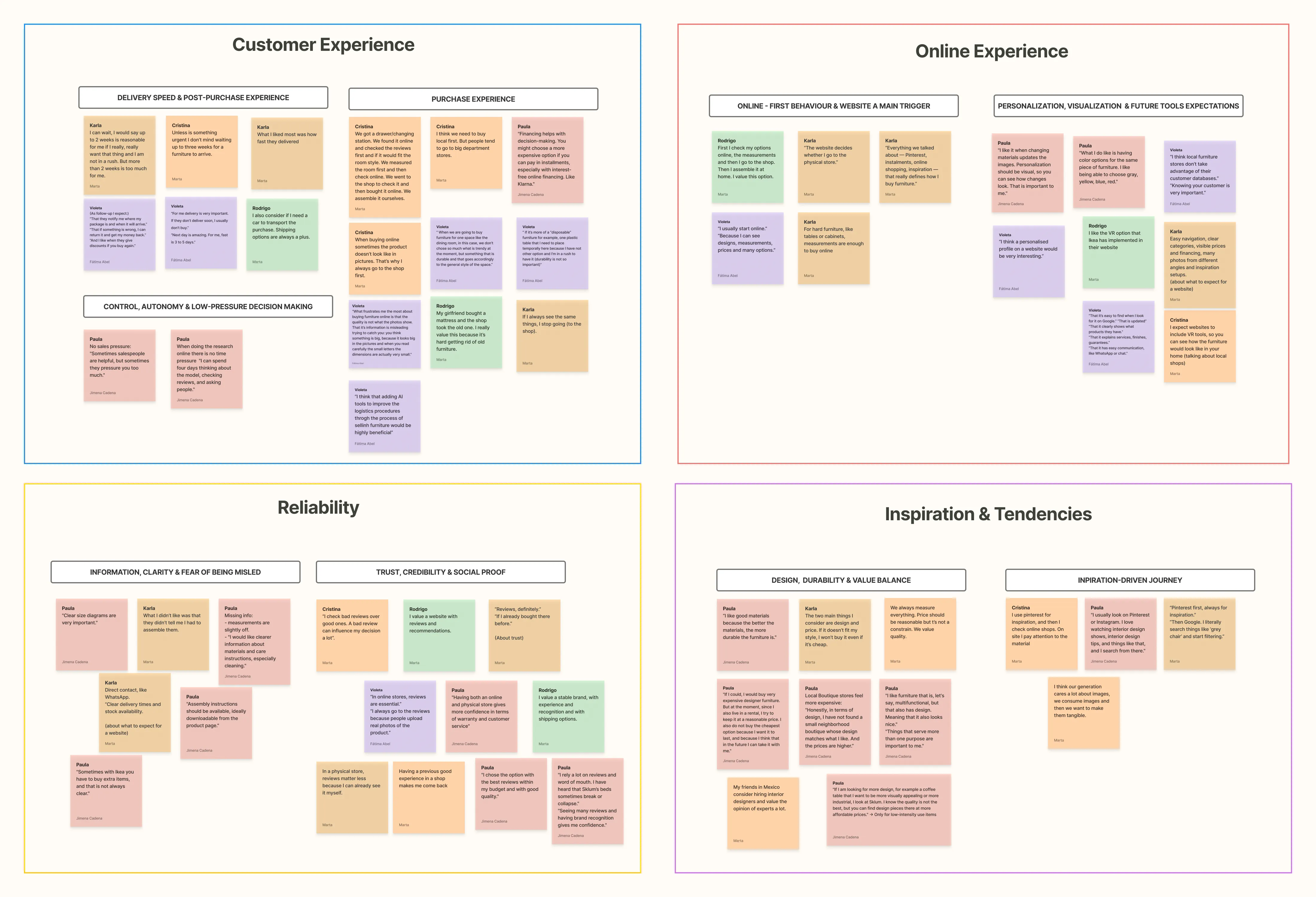
To make sense of diverse customer voices, we synthesized interview insights into a structured affinity diagram—transforming raw data into four key core dimensions: Customer Experience, Online Experience, Reliability, and Inspiration; each revealing what truly drives the furniture purchasing decisions.
User Persona
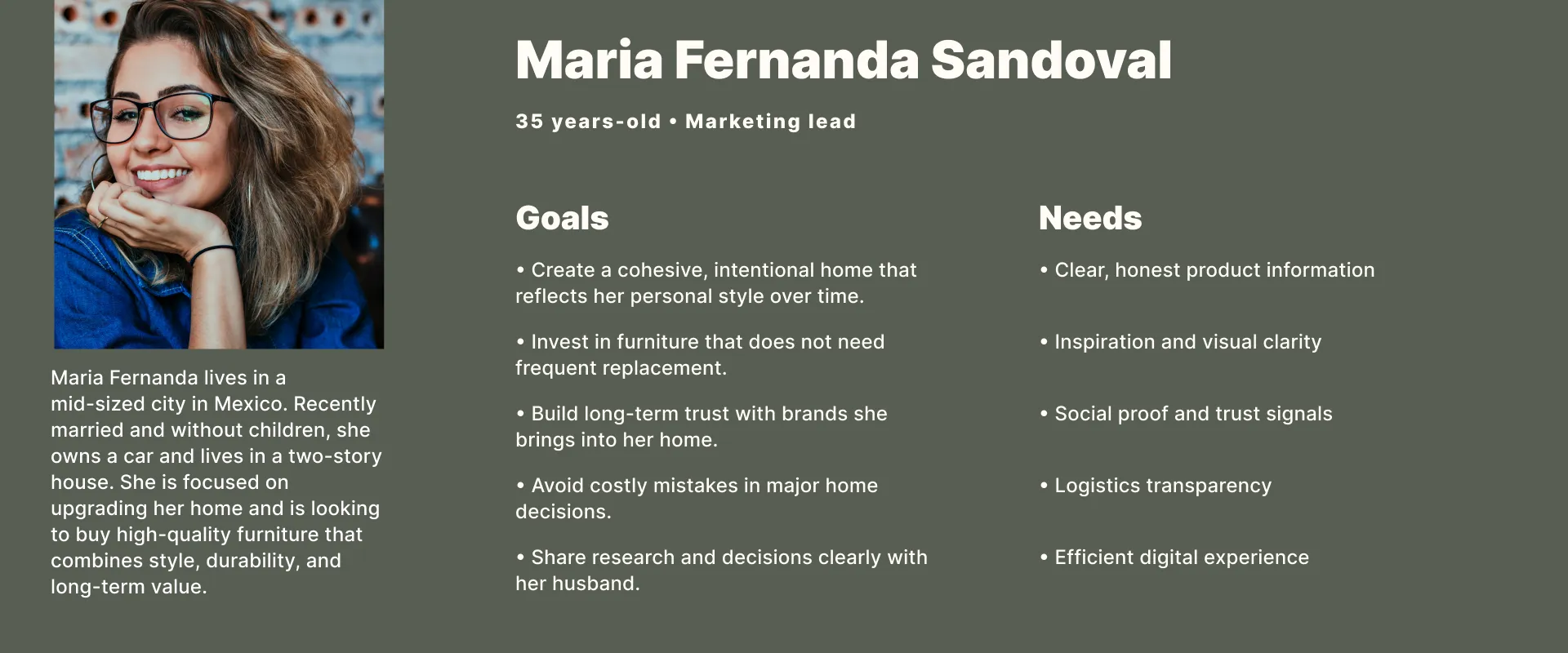
By synthesizing patterns from the affinity diagram, María Fernanda emerged as a representative user persona—bringing to life the behaviors, motivations, and pain points identified across users.
María Fernanda is not casually browsing—she’s investing. As a marketing lead entering a new married life stage, every purchase she makes for her home carries weight. It’s not just about aesthetics; it’s about creating a space that reflects who she is becoming.
She approaches the process with intention. She researches, compares, saves inspiration, and carefully evaluates each option. Her goal is clear: to build a cohesive home, make confident decisions, and invest in durable, long-term pieces.
But her journey is far from seamless.
She constantly encounters friction—product images that don’t match reality, missing key information, unclear delivery timelines, and unreliable digital experiences. Each gap introduces doubt, turning an exciting process into a stressful decision-making journey.
What María Fernanda is truly seeking isn’t more choice—it’s reassurance. She wants to feel certain, to trust the brand, and to know her decisions are informed, not risky.
She doesn’t need more options—she needs clarity, confidence, and trust.
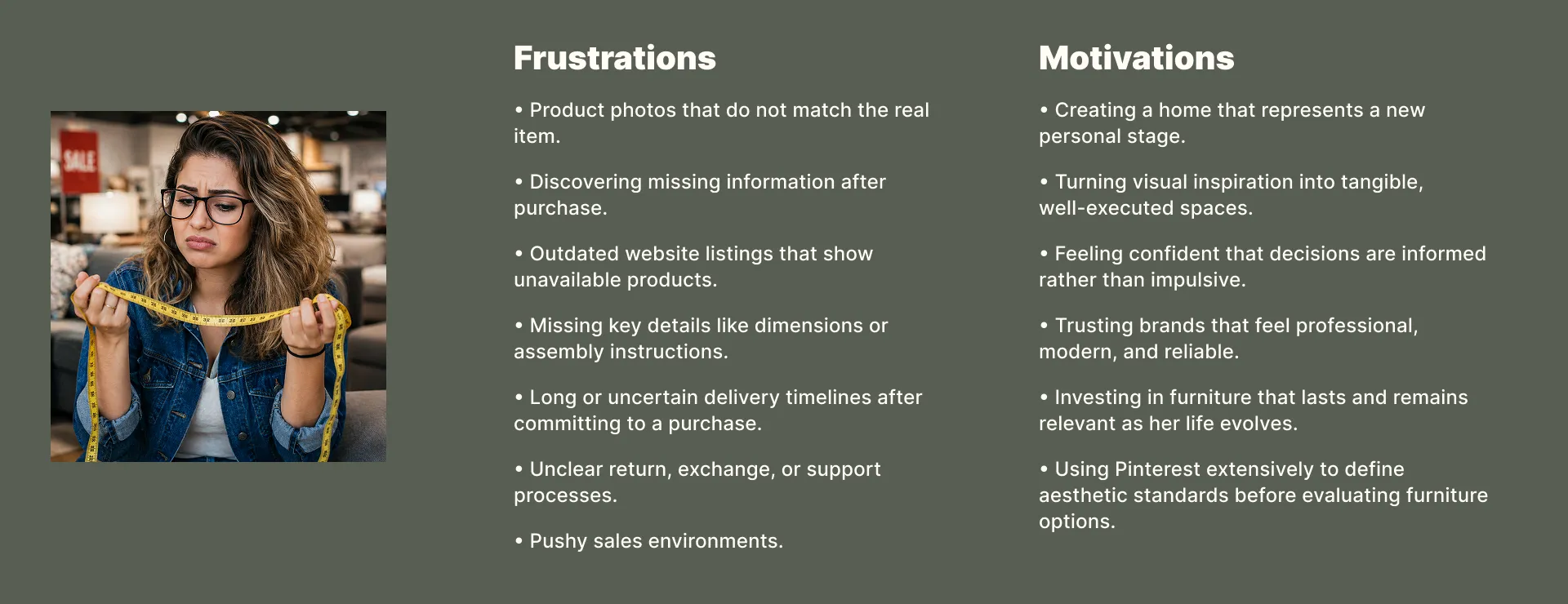
User Journey Map
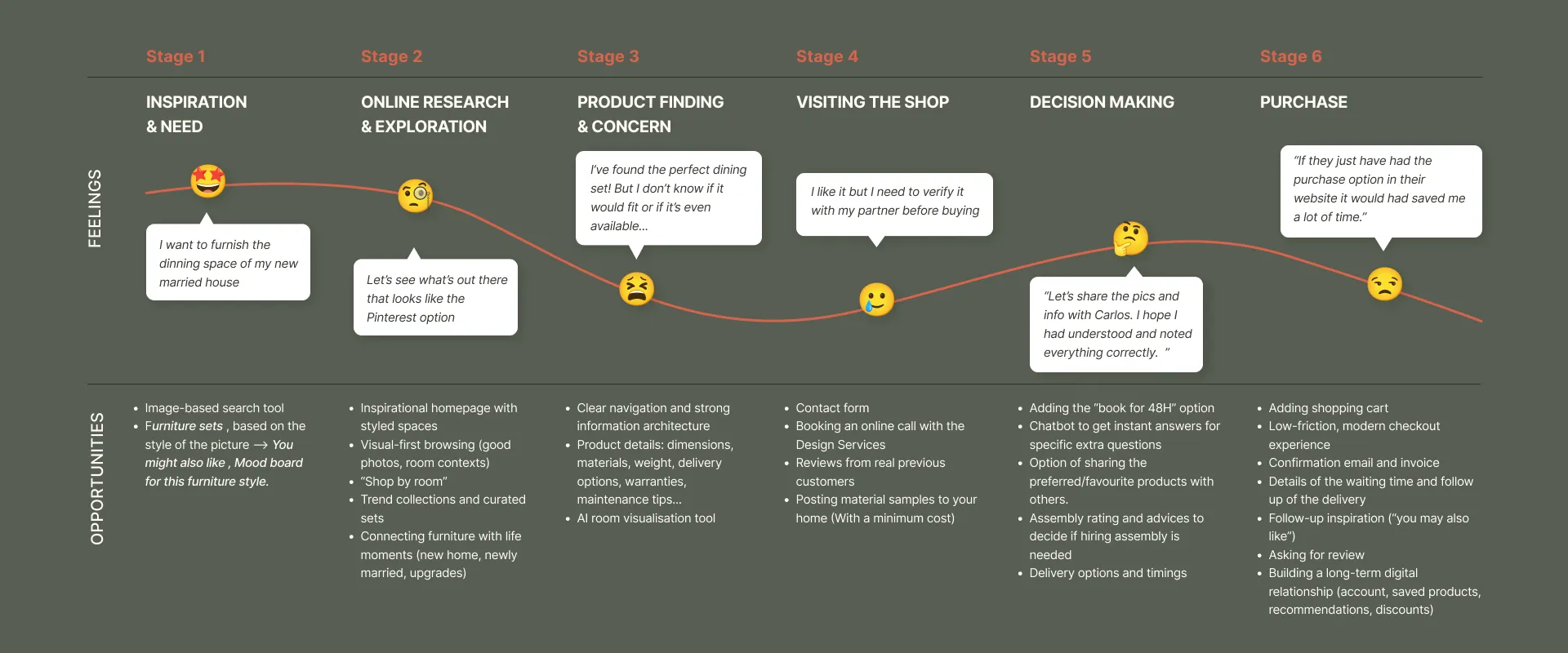
Problem Statement
We identified a critical gap between user intent and digital support, which is illustrated in the following problem statement.

Ideation
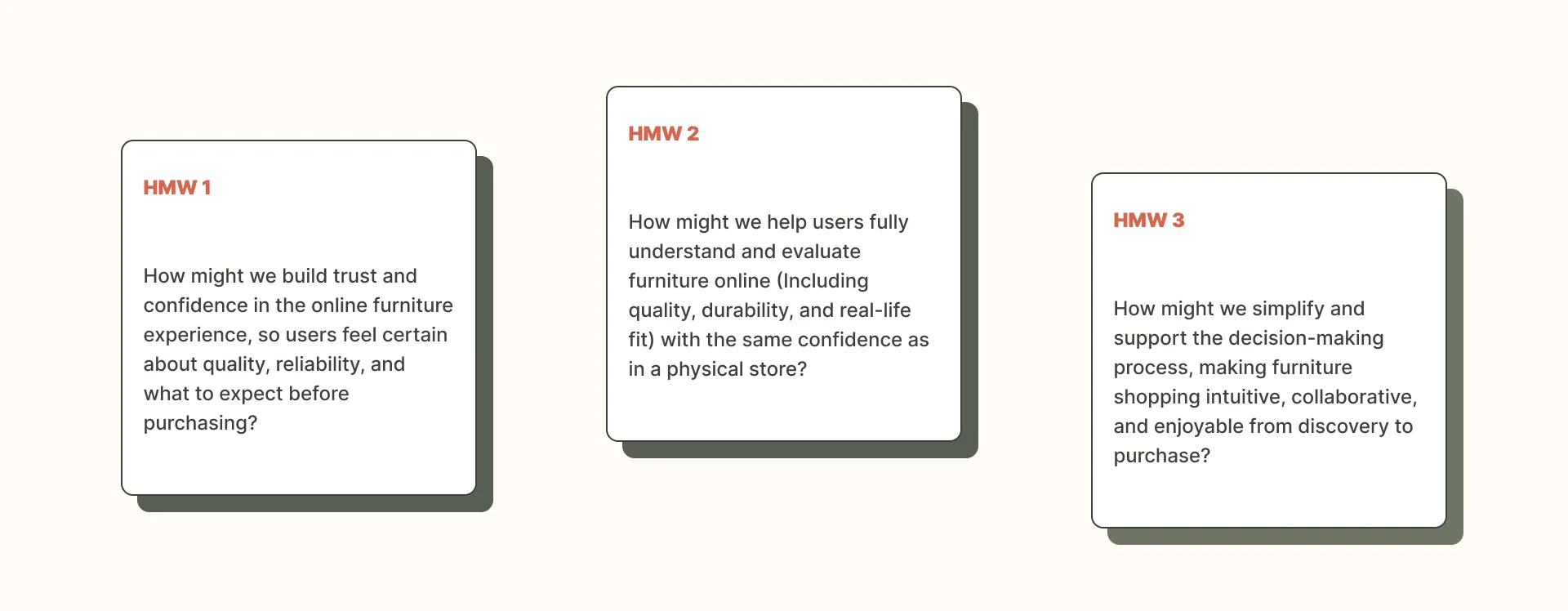
How Might We…
We focused on answering the three below How Might We questions, from which we brainstormed a long list of solution features that later on we discussed.
Some explored concepts were:
Visual-first browsing (room-based navigation)
Rich product detail pages
Comparison tools
Trust signals (reviews, real photos)
Simplified checkout flow
Develop
Moscow Method
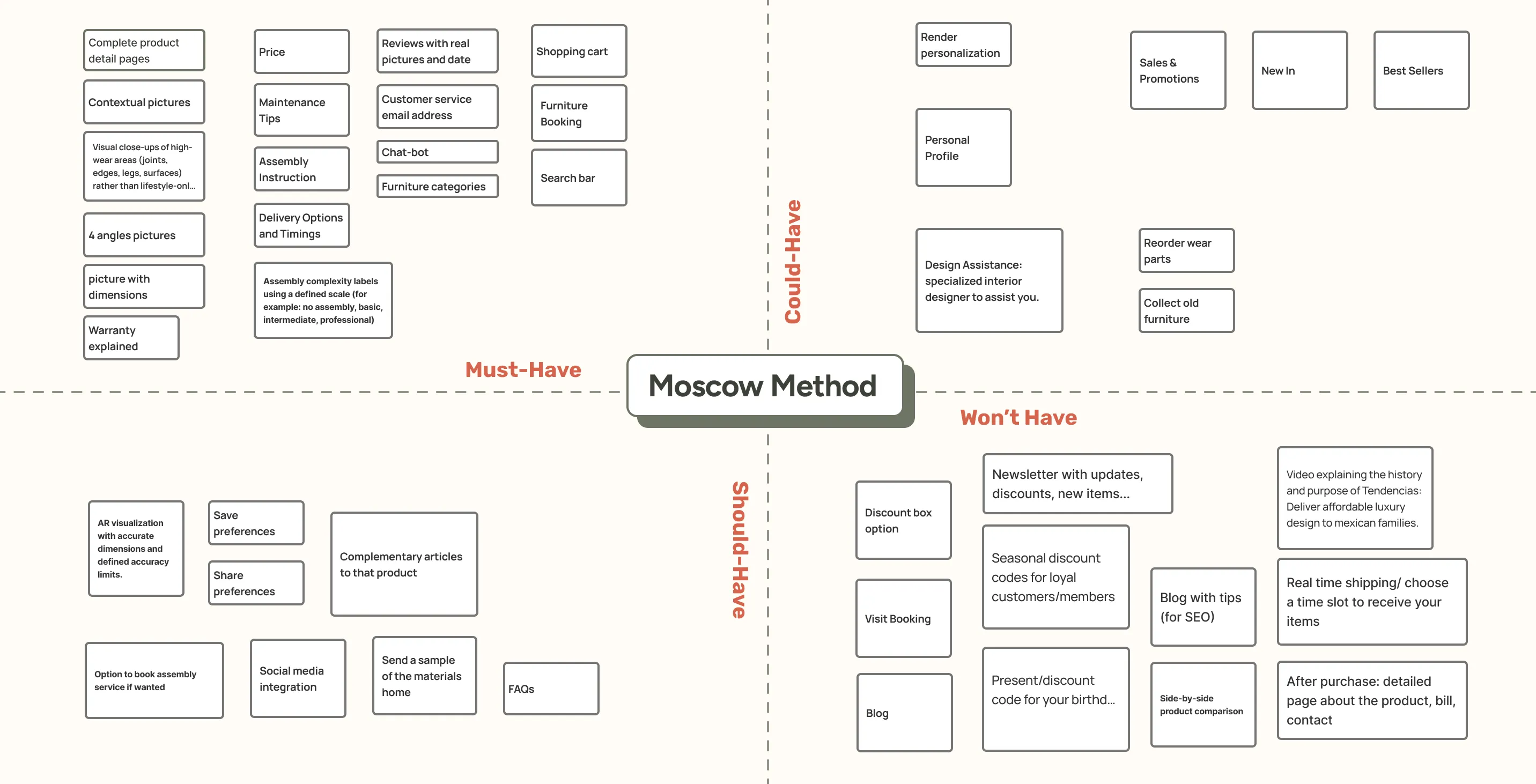
Minimum Viable Product (MVP)
The MVP focuses on one clear goal:
👉 Help users confidently evaluate and purchase products end-to-end.
A streamlined experience combining discovery, comparison, and purchase into one seamless flow.

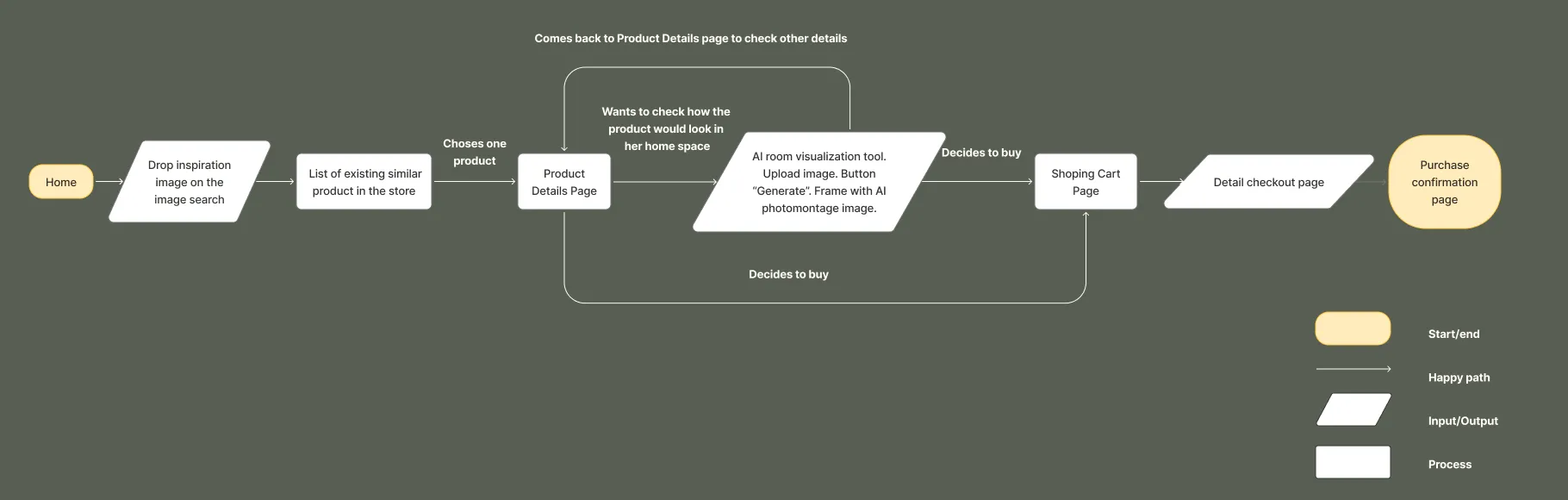
User Flow
We mapped a frictionless “happy path” from homepage → AI similar product search → product → AI spatial visualisation→ checkout.
Every step was optimized to:
Reduce hesitation
Increase clarity
Maintain momentum
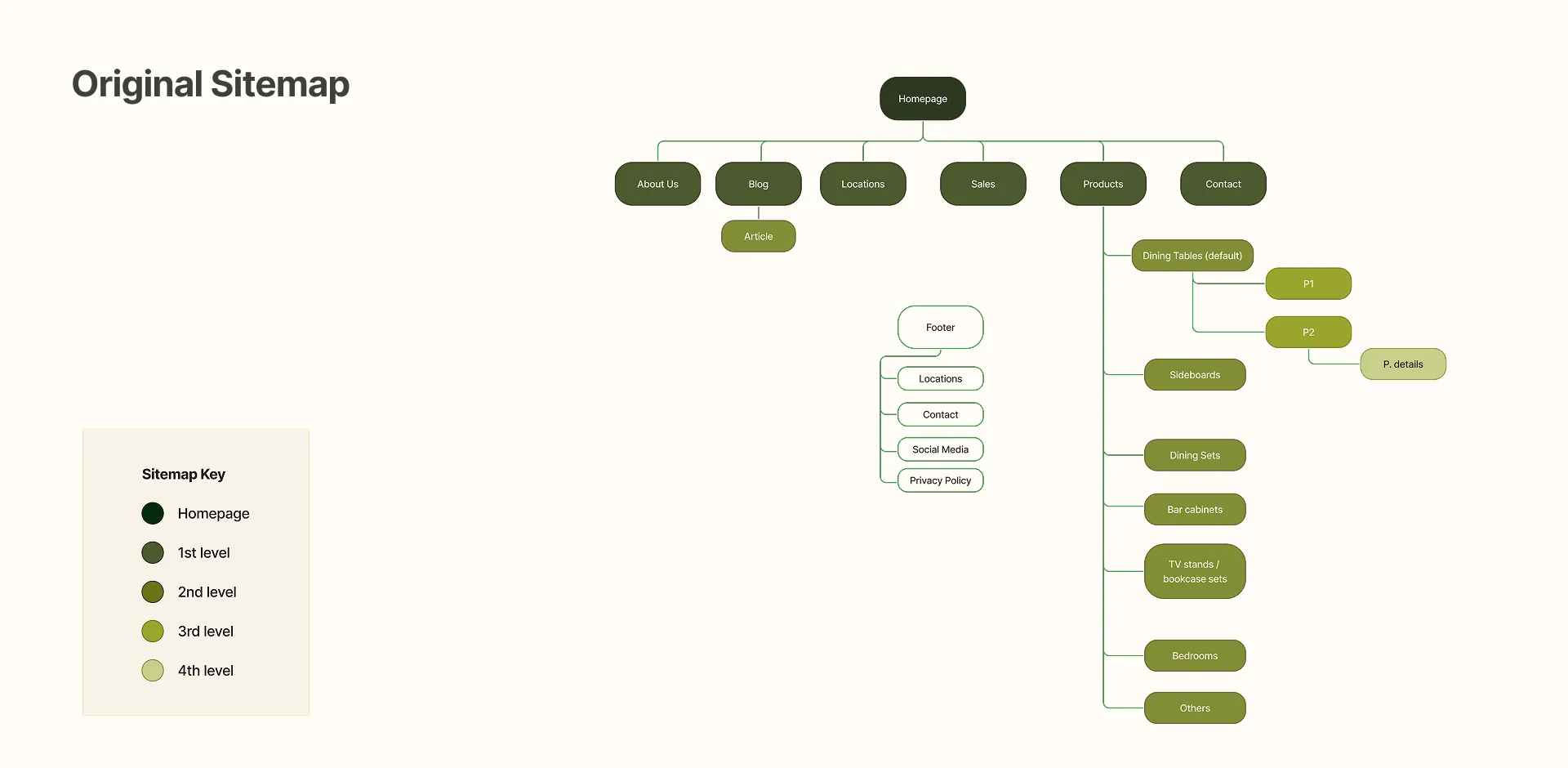
Site Map
The original sitemap reflected the same friction observed in the journey—hidden categories, and weak hierarchy. Users were forced to navigate without a clear mental map, making both exploration and decision-making harder than necessary.
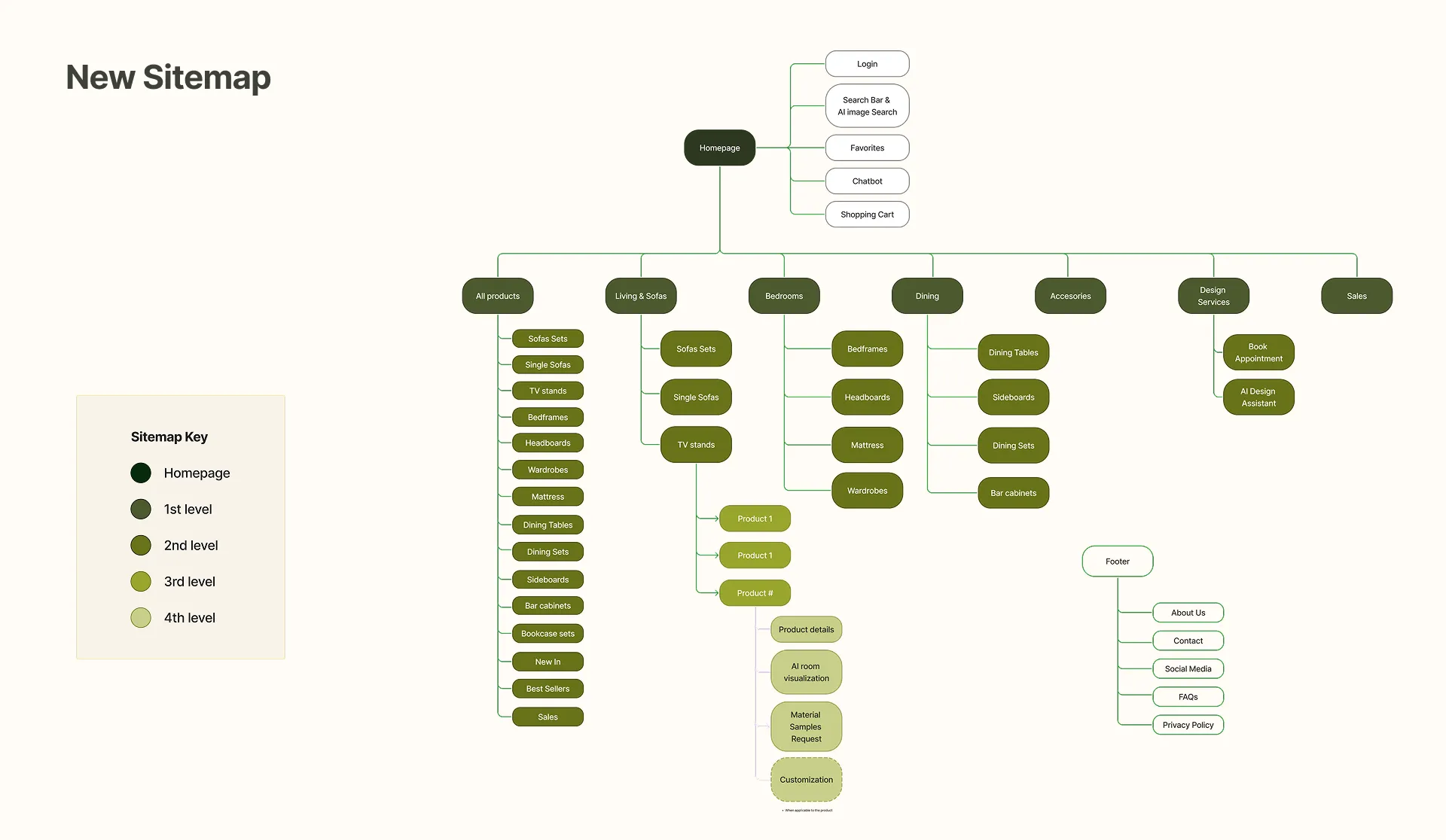
The redesign rethinks the experience from the user’s perspective.
It introduces clear categories and a logical hierarchy, allowing users to understand where they are and where to go next. The structure is aligned with real user mental models—organizing products by how people naturally think about their home (Living, Dining, Bedrooms), rather than internal business logic.
At the same time, it supports both inspiration-driven exploration and goal-oriented search. Users can either browse by category or quickly navigate to specific products, reducing friction across different entry points.
What was once a confusing navigation system becomes a guided and intuitive experience—designed to help users move from discovery to decision with confidence.
Iterate
Low-Fidelity Sketches & Concept Testing
To quickly validate ideas, we moved into low-fidelity sketches and early concept testing—focusing on structure, clarity, and usability before investing in high-fidelity design.
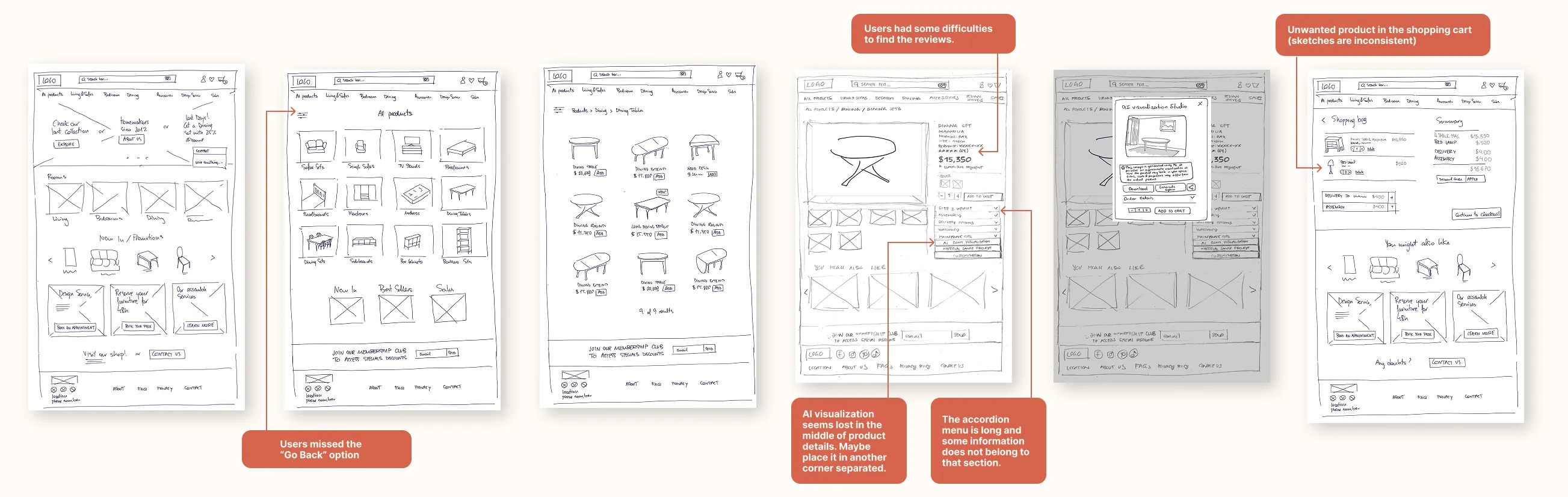
Testing these concepts revealed critical friction points. Users struggled with navigation clarity, missed key actions like “go back,” and found important elements—such as reviews or pricing—hard to locate. Information was often overloaded or misplaced, increasing cognitive effort.
From these insights, we identified clear directions for improvement:
A more simplified and intuitive navigation structure
A stronger visual hierarchy to guide attention
Clearer product categorization aligned with user expectations
More visible pricing and call-to-actions to support decisions
Early integration of trust signals (e.g., reviews, validation cues)
These iterations allowed us to move forward with confidence, ensuring the final design would reduce friction and better support decision-making at every step.
Mid-Fidelity Wireframes & Usability Testing
With the structure validated, we moved into mid-fidelity wireframes and usability testing, focusing on how users interact with the core flows in a more realistic context.
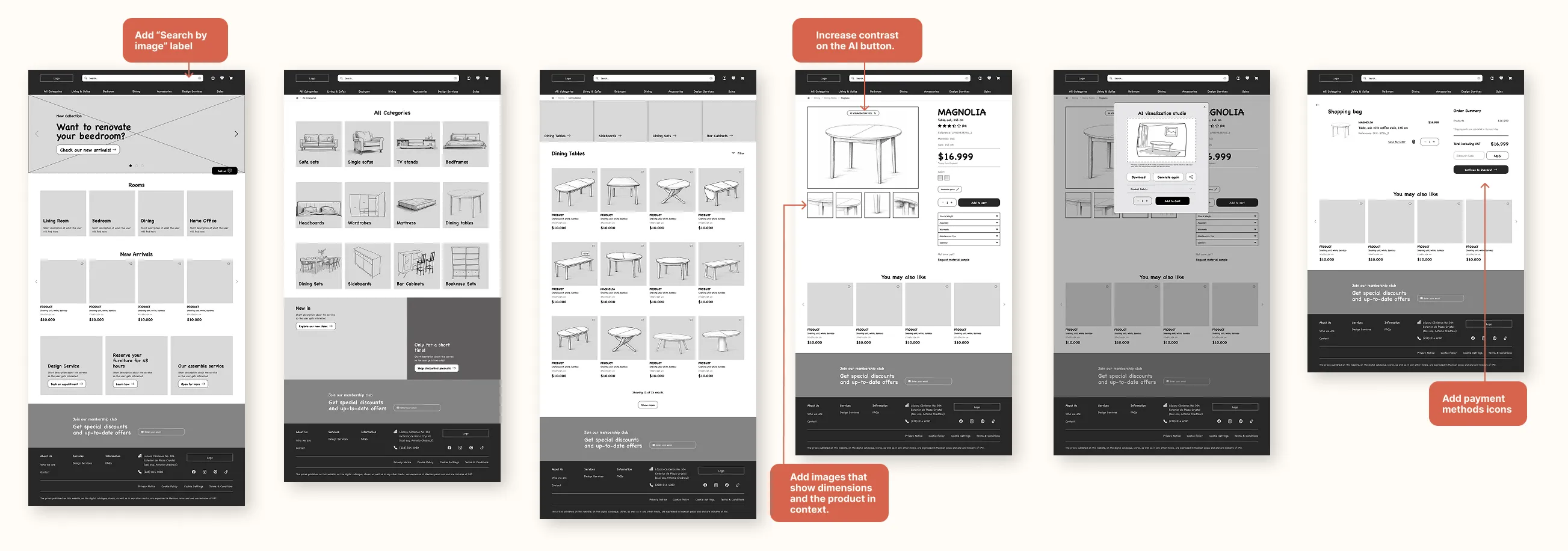
Observing real behavior revealed where friction still remained. Users struggled to scan product pages efficiently, lacked clarity around delivery and availability, and experienced cognitive overload when navigating filters and options.
These insights guided a new round of targeted iterations:
Improved product page scannability, making key information easier to grasp at a glance
Simplified filtering, lowering cognitive load and decision fatigue
Introduced a the “Search by image” label to the AI search feature, bridging inspiration (Pinterest) with product discovery
Added dimensions directly within product visuals, helping users contextualize size without extra effort.
Added the payment methods to the checkout flow.
Strengthened visual cues (pricing, CTAs, trust signals) to support faster, more confident decisions
Each iteration brought the experience closer to its goal: helping users move from exploration to decision with clarity and confidence.
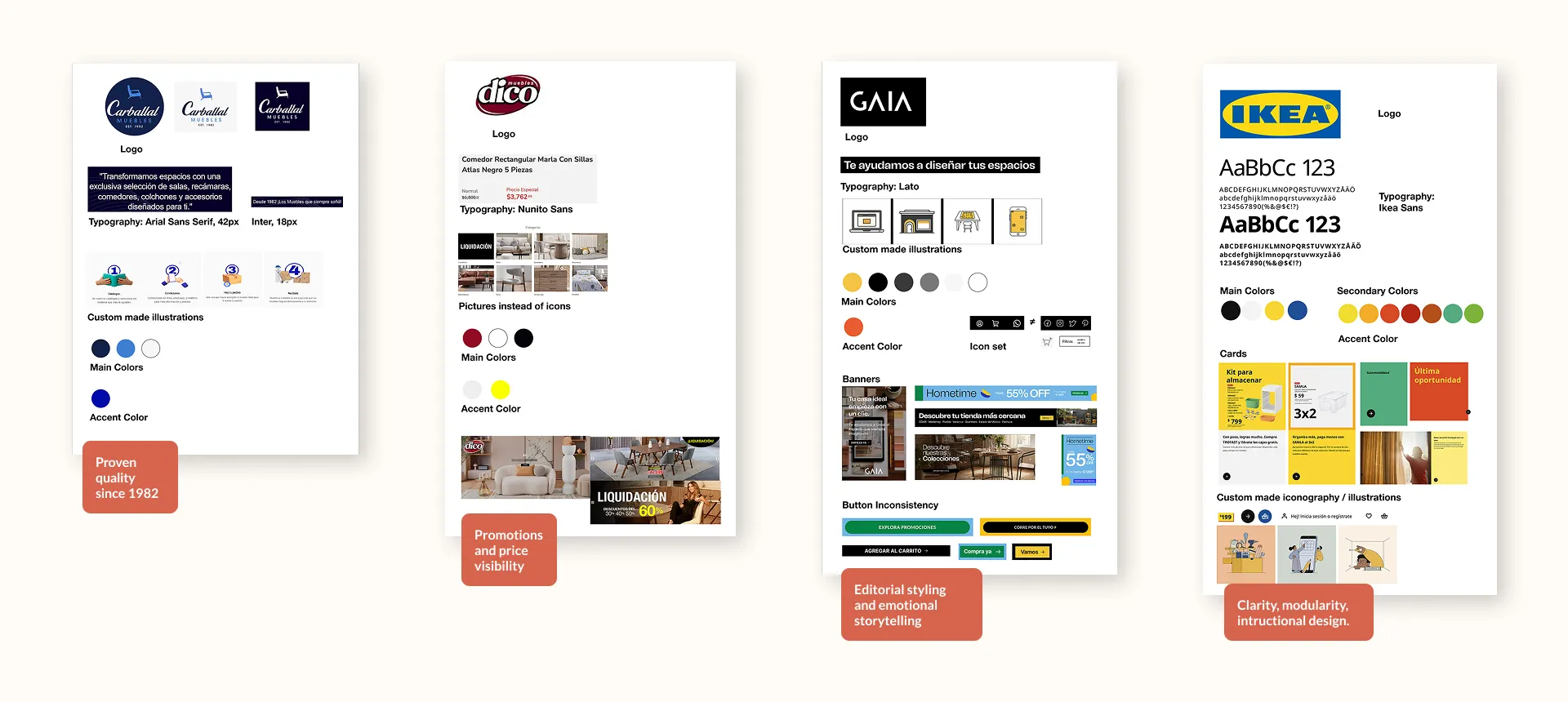
Visual Competitive Analysis
To understand the competitive landscape, we analyzed brands like IKEA, Gaia, Dico, and Carballal, identifying how each positions itself across trust, inspiration, and usability.
A clear pattern emerged.
Some competitors win through scale and usability—like IKEA, with its clarity, modularity, and structured experience. Others compete on local trust and familiarity, leveraging proximity and brand recognition. Meanwhile, brands like Gaia lean into emotional storytelling and editorial design, but often at the expense of consistency or usability.
However, very few successfully balance UX clarity with emotional inspiration.
Key insight: The market is polarized between functional clarity and aspirational storytelling—but rarely both.
Opportunity: Position Tendencias as a brand that is modern, trustworthy, and inspiring—combining clear decision-making tools with a visually engaging experience.
Brand Attributes, Moodboard & Style Tile
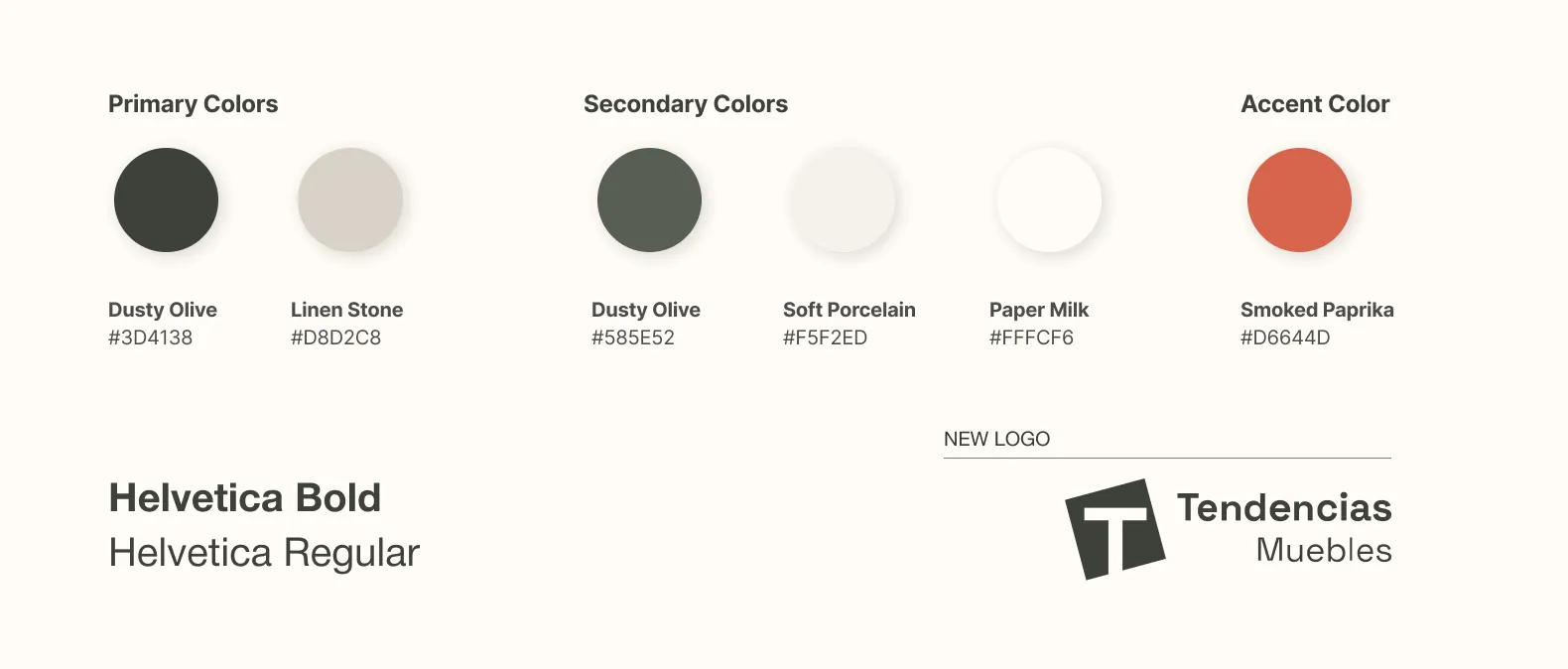
Building on the insights, we defined a new visual direction—one that reflects the balance users were seeking between trust and inspiration.
The brand is positioned as affordable-luxury: elevated yet accessible. It is modern and purposeful, focused on clarity and function, while remaining reliable through consistency and transparency. At the same time, it aims to be inspiring, showing how furniture fits into real, lived spaces—not just idealized environments.
This direction was translated into a cohesive moodboard and style foundation, combining warm, natural tones with clean layouts and minimal, intentional visuals.

To bring this vision to life, we built a scalable design system in Figma, including:
Color and typography styles to ensure visual consistency
A component library (buttons, cards, grids) for reusable patterns
A consistent icon set to support clarity and navigation
A defined spacing system to create rhythm and balance
Custom illustrations to reinforce brand personality
This system ensured not only consistency across screens, but also scalability and efficiency, enabling the product to evolve while maintaining a strong and cohesive identity.
High-Fidelity Prototype & Responsiveness
With the design system in place, we translated the experience into a high-fidelity, responsive prototype, ensuring consistency across all key touchpoints.
Core flows were optimized to work seamlessly across mobile and tablet, adapting layouts while maintaining a consistent and intuitive experience. The result is a flexible and scalable experience, built to perform consistently across contexts while supporting confident decision-making on the go.
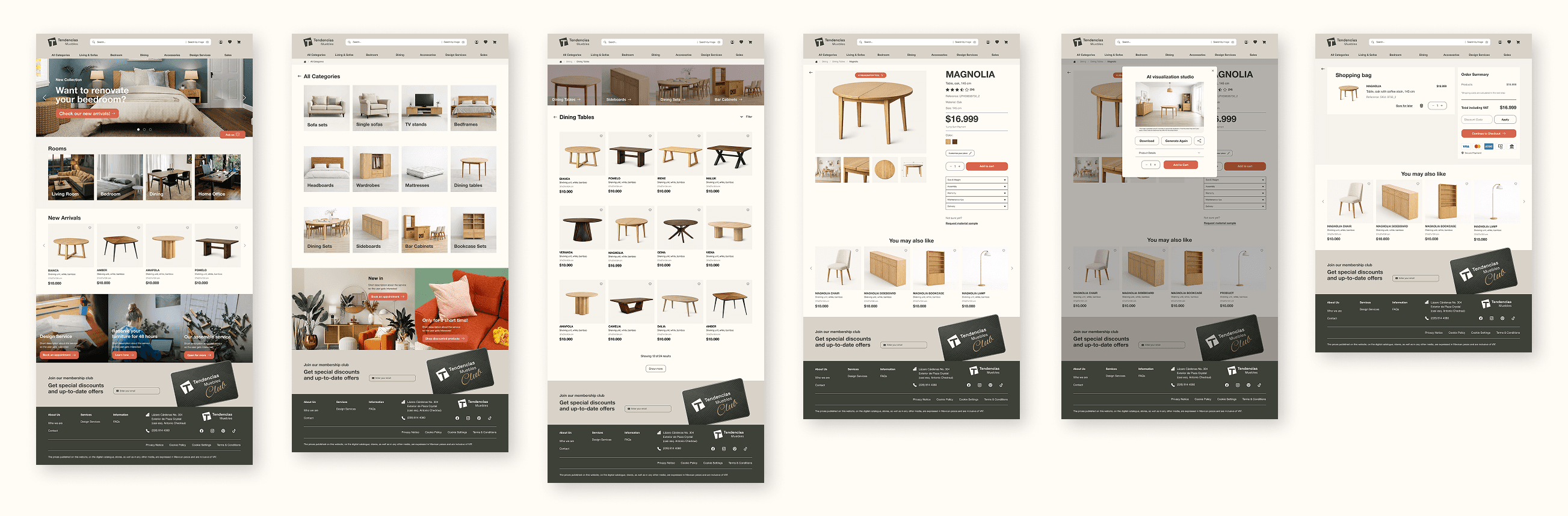
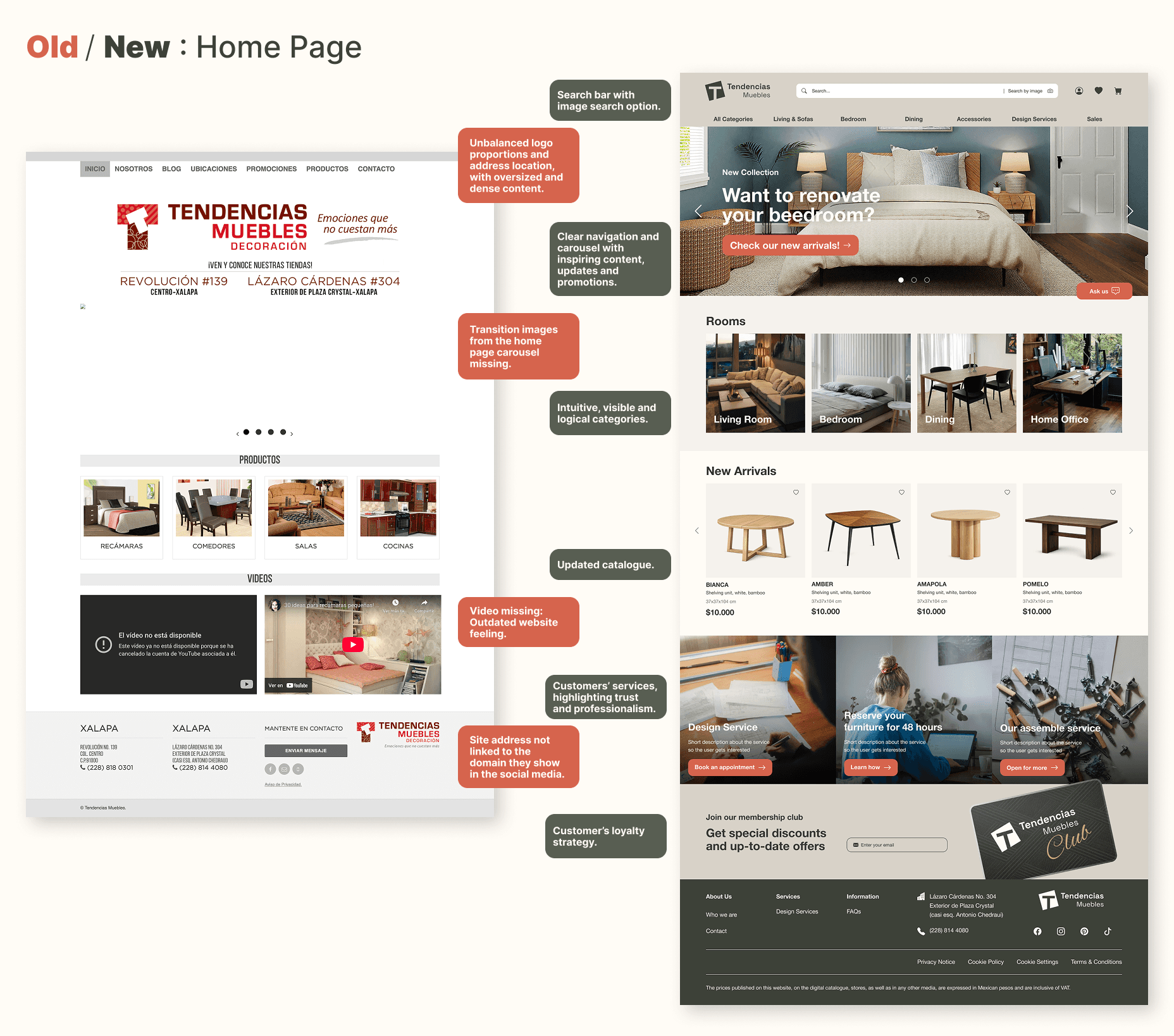
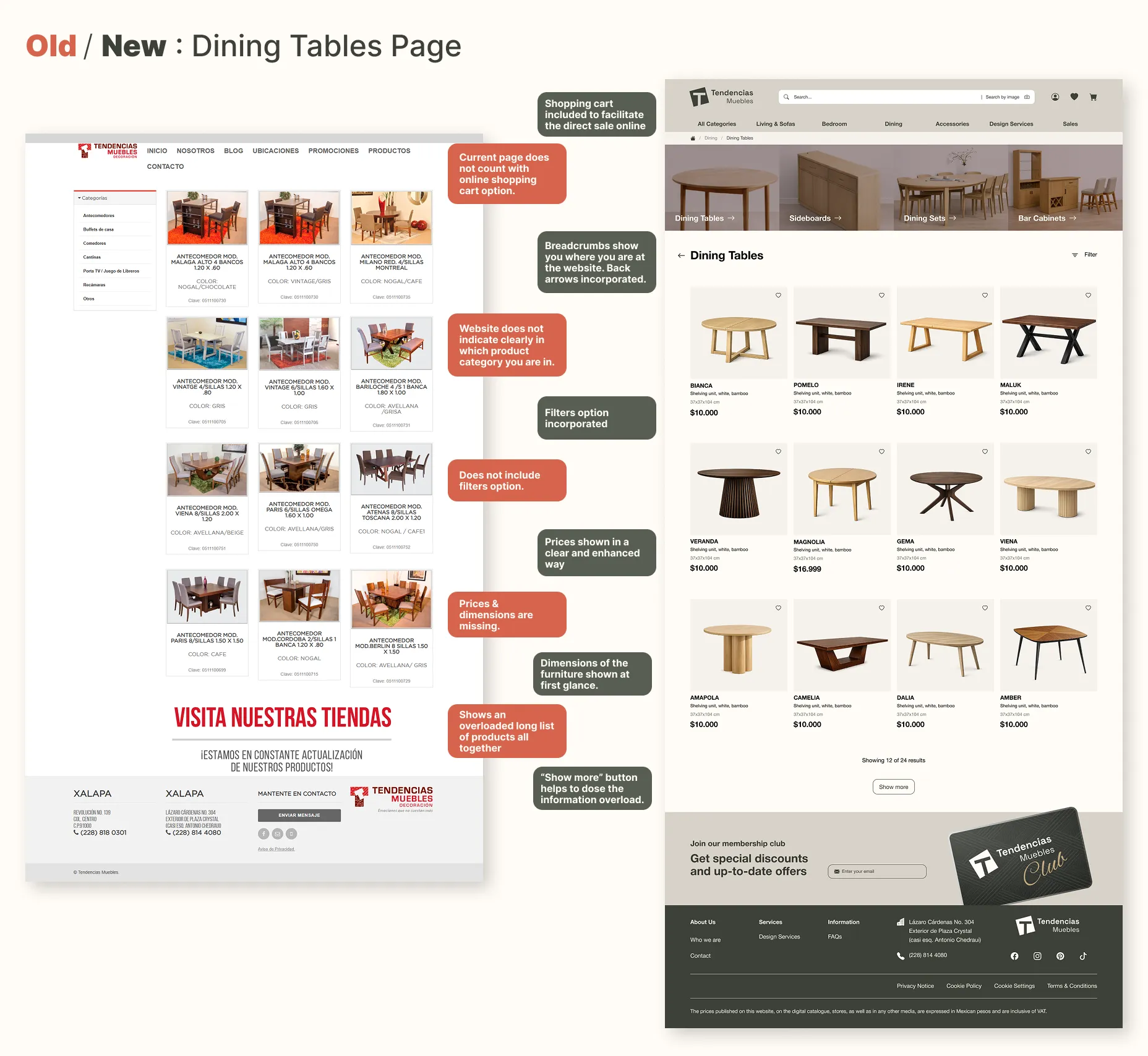
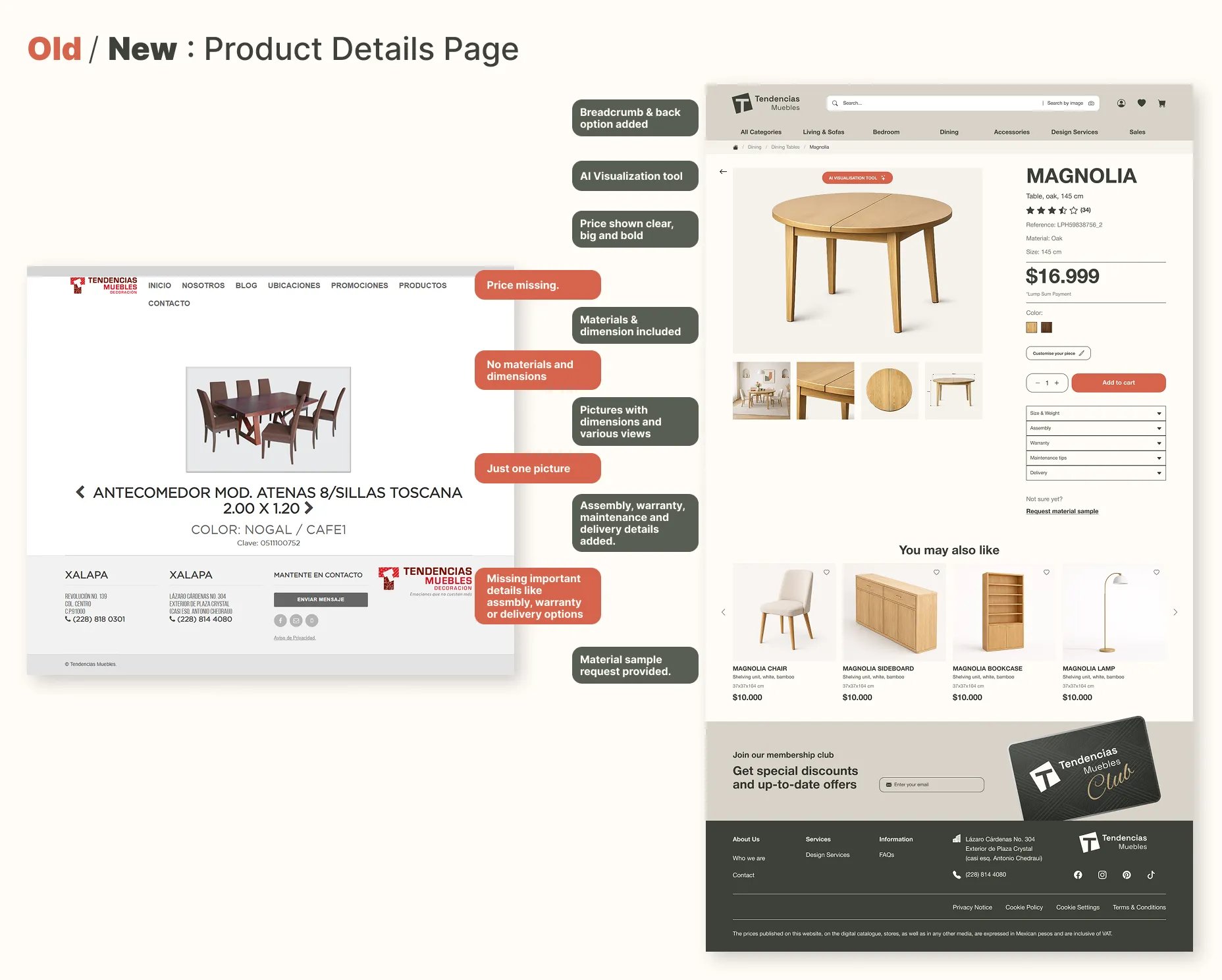
Old vs New Final Result
Final Thoughts
Back to top